
We Made Them Better Traders. They Still Lost.

I helped design a crypto trading app.
It was fast, it was fun, and it worked. People got better at trading with it.
They still lost their money.
Both of those sentences are true. The gap between them is the most useful thing I’ve learned as a designer.
The idea in 20 seconds
- We removed the scary charts and made trading feel calm and simple.
- People genuinely got better at individual trades. That part worked.
- But you can win most of your trades and still lose money. The maths doesn’t care how good the app feels.
- A market moves on human behaviour you can’t put in a number. You can only automate the part that’s already numbers.
- Making someone better at a task isn’t the same as helping them win.
What we built
The product let you trade crypto “perps”: fast, leveraged bets on which way a price will move.
Normally that means candlestick charts and jargon. Frightening for most people.
So we took the charts away.
We replaced them with a simple visual dictionary. Green tag: Bullish. Red tag: Bearish. A friendly mascot to translate the rest.
Three taps to place a trade. A loading bar that named each step out loud (“sending to exchange… awaiting confirmation”) so your money never felt lost, even if you closed the app.
Every one of those was a good design decision. People felt calm. People felt smart. People traded.
How can you win most of your trades and still go broke?
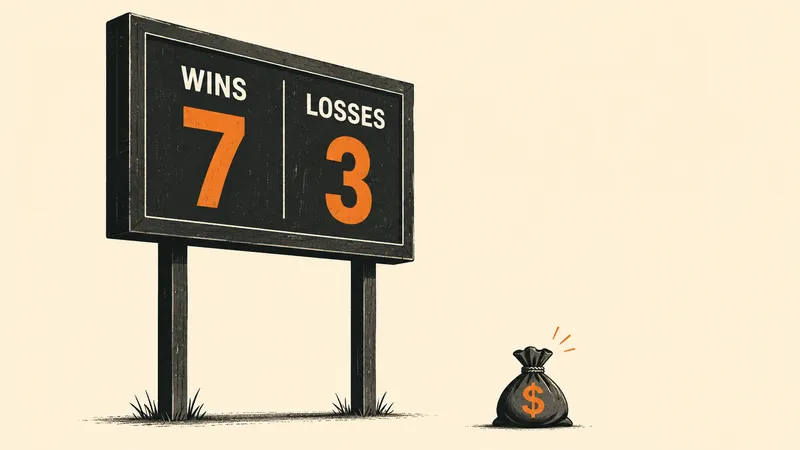
Say you win 70% of your trades. Sounds like winning, right?
Now say your wins are small and your losses are big. A typical win of +0.30%. A typical loss of −1.00%.
Do the sum:
0.70 × 0.30% − 0.30 × 1.00% = −0.09% per trade
You won seven times out of ten and still went backwards. And that’s before a single fee.
Now flip it. Win only 40% of the time, but make your winners twice the size of your losers (+2% against −1%):
0.40 × 2% − 0.60 × 1% = +0.20% per trade
You lost most of your trades and came out ahead.
Winning the argument isn’t the same as winning the war.
And it gets harder. Leverage doesn’t improve your odds. It just multiplies your wins and your losses together, and drags the moment you get wiped out much closer. Fees and funding quietly raise the score you need to break even.
Stack it all up and the picture is brutal. EU regulators force brokers to print the number on their own homepage: 74% to 89% of retail accounts lose money. A study of Brazilian day traders found 97% lost over time.
The house doesn’t need to cheat. The maths is the house.
The thing we didn’t know
When we designed it, we didn’t know any of that.
We honestly believed the analysis would give people an edge. In a narrow way, it did. People got better at reading a chart, better at picking a cleaner entry.
What we couldn’t see was that the game underneath was never a skill game.
You can’t automate the part that isn’t numbers
A market isn’t maths. It’s people. Fear, greed, and a handful of whales who can shove the whole board with one move.
Our AI read the numbers beautifully. But the thing moving the numbers was human behaviour, and human behaviour doesn’t fit in a cell in a spreadsheet.
It’s like getting good at picking the fastest queue at the supermarket. You really can improve. But if the shop keeps opening and closing tills at random, your skill barely matters. The system moves faster than your reading of it.
We automated the analysis. We couldn’t automate the part that actually decided the outcome, because that part was never numbers.
What it taught me
Making someone better at a task isn’t the same as helping them win.
A design can nail the metric it can see, like cleaner trades and faster taps and more confidence, while the real outcome, the one that lives outside the app, quietly moves the other way.
So before I make something easy now, I ask a harder question:
Easy to do, or easy to lose?
One last thing
I’m proud of that app. Some of the best interface work I’ve done.
And it was a beautiful front door to a game most people can’t win.
Both true. I’m leaving it there.
Sources and further reading
More writing
 human factorssystems design
The Game Was a Disguise
A protest campaign for Afghanistan's banned women cricketers, and the lesson that design's first job is to protect the people in it.
 systems designerror preventionhuman factors
The $125 Million Unit Label
The Mars Climate Orbiter was lost at the boundary between two teams, and that boundary is where many systems actually fail.
 human factorserror preventionsystems design
The Word "Takeoff" Had Two Meanings
The Tenerife airport disaster shows why critical systems cannot rely on language that merely sounds understood.